Thoughts on Solar

I took an introductory class about solar powering one’s home at TxRx Labs. It was very well done — I learned quite a bit about maximizing energy and the difference between a cheap controller and an expensive one (hint: the features included in the expensive version are necessary if one is serious).

One of the topics that kept coming up was ROI (return on investment). How long before you “pay off” your system by selling the electricity to the grid? There were all sorts of charts and the like provided on what kind of system, how big the panels, etc.

I realized that I don’t care. My goal in going solar isn’t to make money or pay off anything. It is simply to take that expense out of my life forever (or for several decades). I won’t have to worry about running my A/C during the summer and getting a massive bill. I won’t feel cheated because I have to pay $30 for the cost of the lines and poles on top of my usage (which often falls below the “minimum” amount, so I get a mandatory fee on top of that).

To a lesser extent, I’ll feel a bit more treehugger-ish because I’m not relying on dirty power generation. If I can add enough capacity to charge an electric car (or at least top it off), that’s even better.

Attaching the House to the Trailer

From my own research, this is a “controversial” topic: some folks say it is required and others say not to bother.

Someone is *wrong* on the internet!

Does it make sense to attach the house to the trailer? The weight of the house should be enough to keep it on the trailer as in, will it blow off while you’re driving down the road? No. If I’m worried about tipping over, then the house is destroyed anyway.

Tumbleweed suggests welding threaded rods onto the trailer that are then passed up through the subfloor, sole plate of the wall and a HDU5 holdown. I decided to not go this route, because I would have had to strip the paint from the trailer and I didn’t like the position of where I’d have to place the rods (too close to the interior of the house).

So what to do?

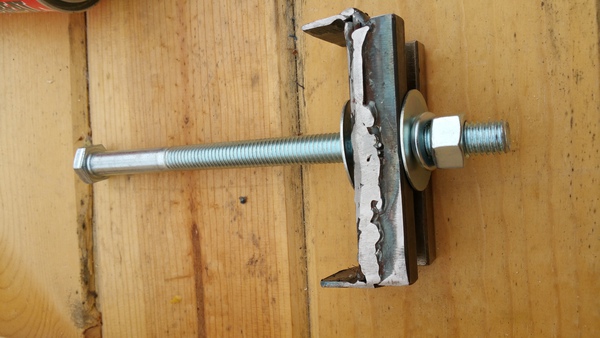
It turns out that my trailer has stake pockets for adding a railing. So my idea is to create a bracket that will clip to the bottom of the bracket and hold a threaded rod.

The completed bracket with rod
[envira-gallery id=”90″]

Here’s a video of me welding the plate and then grinding and polishing it.

What about all your stuff?

When moving to a tiny home, space is at a bare premium. All those “things” I kept around and never used needed to get the heave-ho.

“Take only what you need to survive, Princess Vespa!” I kept reminding myself. But then I remembered that my name isn’t Vespa and I’m not a princess. Oh well.

When cleaning out, I did it in short bursts. When I got really discouraged, I watched the Best Damn Cleanup Motivational show in the world, ever. That got me juiced enough to dump stuff I was sure I really needed.

No, really. I need that.

Like in the show?

Yes, but this is different.

Really? Like how you yelled at the screen, “It is friggin busted and old, THROW IT OUT!” and they kept it anyway and you were like, “Ooohhh, dummy!”

Uh, yeah.

So…?

So, I’ll throw it out.

Good man.

Clothes

Yes, yes, of course donate them, even if it doesn’t matter. Remember, if you really, really, really, really need something you can always buy it again later. No, seriously.

  • If you haven’t worn it in 6 months/a year, GONE.
  • If it doesn’t fit — too big or too small, GONE. (Buy a new one when you’ve slimmed down/bulked up).
  • If has holes, busted zippers, missing buttons or tears or seams are coming apart, GONE.
  • If it has stains and has been sitting in the “I’ll fix it” pile for more than a month, GONE.

Books

I love books and I have a BAZILLION of them. So, this was hard. Here are the general rules I used. Some stuff I donated to the library (they hate me now), and other stuff I just recycled.

  • If it is a school/college textbook, GONE. No, I don’t care; you can use the interwebs if you really want to look up how many electrons are in the outer orbit of Sodium.
  • If it is ripped, missing cover, pages falling out, soaked with coffee, moldy, or otherwise damaged, GONE.
  • If it is a technical book that is more than a year old IT IS OBSOLETE. GONE.
  • If it is outdated (“How the economy will crash in 1985”), GONE.

Newspapers/Brochures/Flyers

Recycle them all, I’m not kidding. If you can’t be bothered to recycle them, then just landfill. You aren’t going to read those things you’ve been saving, ever.

Magazines

WTF? 99% are GONE. There better be a damn good reason to keep one, and consider keeping only the pages you need.

Organizing tubs/geegaws

You don’t need them. You’re going so small, you won’t have anything to organize.


I Got Wood

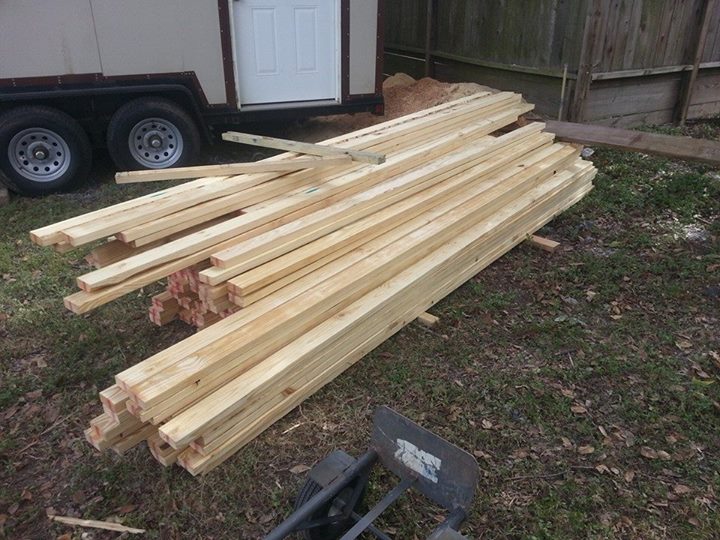
My order for wood arrived from the supply yard. Compared to other orders, mine was miniscule of course. The guy dropped it off in the yard.

2014-11-03a

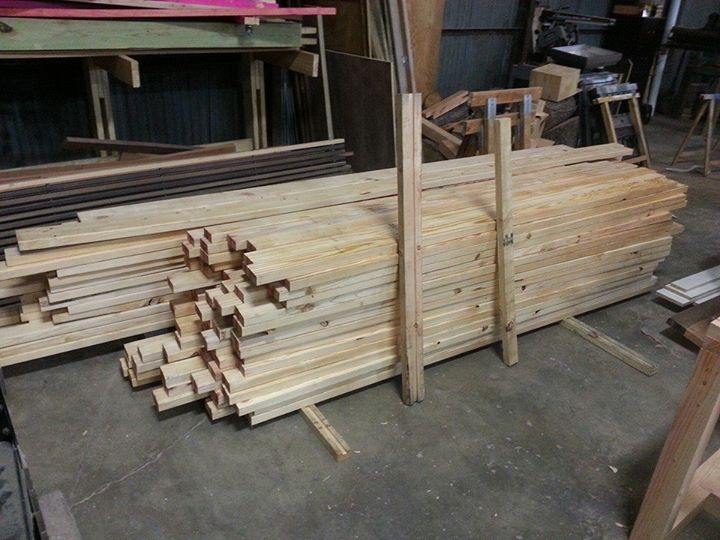
A short while later I had it moved into the storehouse.

2014-11-03

The Trailer

The Tiny home starts with the trailer, and there are several reasons for this:

  • It provides the solid foundation that supports the house.
  • As a designated “Travel-Trailer”, no home inspections are required*.
  • It is illegal to live in a structure as small as the Tiny home**
  • When moving day arrives (or you want to get out of town for a while), just hook up the truck and go.

* Your results may vary due to local laws. Also, by not having your home inspected it is on YOU if you build crap that falls down and kills someone. YOU must build and build well, my friend.

** For a number of reasons: many communities don’t want vagrants camping on their streets; to prevent Tenement-squalor conditions; etc.

2014-09-29

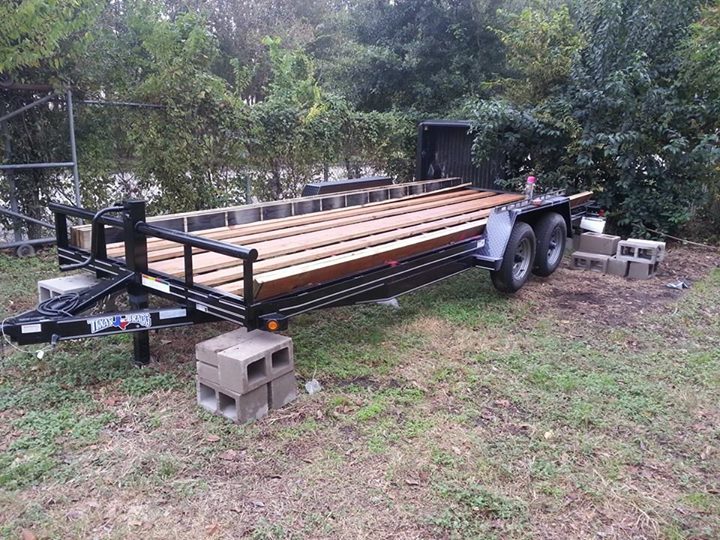
When picking a trailer, there are three things you will want to look for:

  1. A flat bed with wooden planks. No dovetails (the slope at the end to aid in loading vehicles), because this will make it harder to build your subfloor. You want wooden planks so you can remove 1/2 of them and lighten up the trailer.
  2. For my 96″ x 20′ trailer, I made sure mine had a GVWR of 10,000 lbs (5 tons) and a double-axle. Tiny house will be heavy and needs the proper support.
  3. No railings. Tiny house will extend to the edge of the trailer and a railing will get in the way. On my particular trailer, the construction required a front railing, so I am building around that.

Other considerations

  • Get a hitch lock. Don’t be this guy.
  • Make sure you know what kind of electrical connection your trailer will require and get an adapter to fit whatever truck you’re using to haul it. You can get these adapters at auto-parts stores, onine and probably places like Harbor Freight. They’re like $15-30 and better than getting a ticket for having no tail lights/turn signals.
  • Get insurance, because it is dirt cheap and you don’t want to be an idiot with no trailer because you were cheap. When you finish building your house on the trailer you will need more insurance, but that can wait for another day (don’t forget!)
  • If you plan on moving your house a bit, consider getting a spare. Trailer folk I spoke with mentioned that blowouts are common, so having a spare can mean the difference between being stranded in BFE and getting to where you’re going.
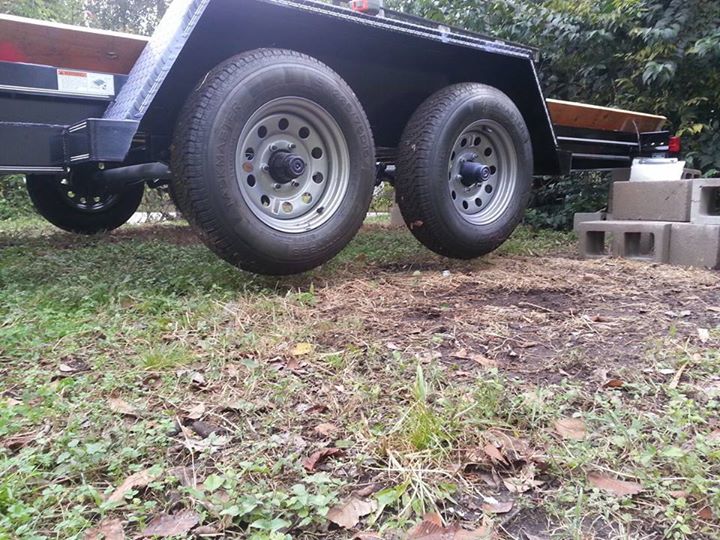
  • If I had to do it again, I’d get built-in jacks, because it would’ve been much easier to raise and level the trailer. Parking your trailer for long periods in the same spot will ruin the tires unless you raise them off the ground. I ended up using a 6 ton-capacity bottle jack and a bunch of cinder-blocks to do the job.

2014-11-06b 2014-11-06a

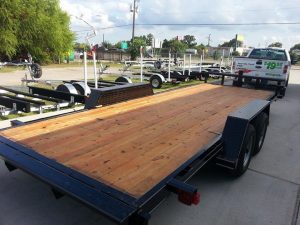
I shopped around and got my trailer for low-$4,000s. I could’ve gotten one for about half that off Craigslist or whatever, but (at the time), I didn’t know much about trailers and how to tell if they were still in good condition.

Start Here

Here it begins, the journey.

I’ll start with the end first. The journey will go in this direction.

The Goal

  • A tiny home about 140 square feet in size, which contains
    • Working Kitchen (Stove, Sink, Oven)
    • Bathroom with sink, flush toilet and shower
    • Bedroom
    • A/C can will run nearly 24/7 during the summer
    • Some kind of living area suitable for watching videos, playing video games, reading or meditating
  • A tool shed/workshop (7’x12′)
  • A chicken coop + chickens (for eggs)
  • A vegetable garden (for producing edible tomatoes, herbs, and other veggies)
  • A deck with a gazebo
  • The whole thing powered by solar,
    • Excess power stored in batteries (for nighttime, during overcast days, etc)
    • Enough capacity to power the house
    • Enough capacity to charge an electric vehicle in a reasonable amount of time.

That’s the current goal. Let’s see what we can do.

Enhanced by Zemanta